
 Image 1 of 2
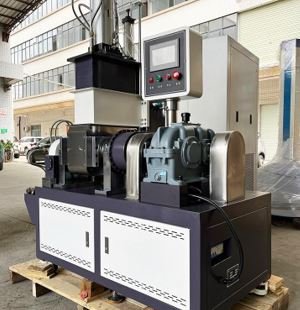 Image 2 of 2
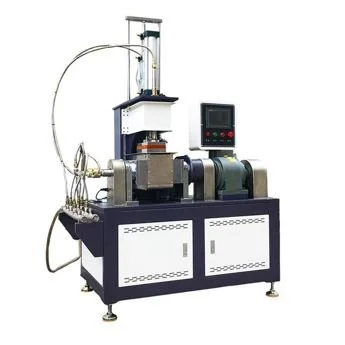
RT-120A Turn Over Type Laboratory Banbury Rubber Internal Mixer
Features and uses: (laboratory) Automatically control the temperature and time system, the operation is precise and simple, and the mixing can achieve the best dispersion and uniformity;
The mixing tank is pourable, and the mixing shaft is leak-proof with a dry mechanical shaft seal, which makes cleaning and color change easy and easy. This sealed mixing tank can ensure the mixture and prevent environmental pollution. The machine is durable and has low failure rate. , installation and maintenance is easy, save electricity.
Applicable products:
EVA foam sole. Rubber sole. TPR sole. Rubber roller. Rubber sponge. Tire. Sports ball, etc.
Uses:
Rubber, plastic and chemical raw materials, mixed and dense processing, lightweight, efficient, energy-saving and environmentally friendly modern rubber mixing.
The internal mixer generally consists of a mixing chamber, two relatively rotating rotors, an upper top plug, a lower top plug, a temperature measuring system, a heating and cooling system, an exhaust system, a safety device, a discharge device, and a recording device. The surface of the rotor has spiral ribs. The number of ribs is two-sided, four-sided, six-sided, etc. The cross-section geometry of the rotor is triangular, cylindrical or elliptical. There are two types of tangential and meshing. . The temperature measurement system is composed of a thermocouple, which is mainly used to determine the temperature change in the mixing chamber during the mixing process; the heating and cooling system is mainly used to control the temperature of the rotor and the wall surface of the mixing chamber. The schematic diagram of the internal structure of the mixer is shown in Figure 2-2.
(2) Working principle of mixer mixing
When the internal mixer is working, the two rotors rotate relative to each other, and the material from the feeding port is clamped into the roll gap and squeezed and sheared by the rotor. After passing through the roll gap, the lower top edge is divided into two parts, respectively The gap between the front and rear chamber walls and the rotor is returned to the top of the nip. During the week of the flow around the rotor, the material is sheared and rubbed everywhere, causing the temperature of the rubber to rise sharply and the viscosity to decrease, increasing the wettability of the rubber on the surface of the compounding agent, so that the rubber is in full contact with the surface of the compounding agent. The compounding agent agglomerates through the gap between the rotor and the rotor, the gap between the rotor and the upper and lower top cymbals, and the inner wall of the inner chamber with the rubber compound, is sheared and broken, and is surrounded by the rubber which is stretched and deformed, and is stabilized in a broken state. At the same time, the ribs on the rotor move the rubber along the axial direction of the rotor to agitate and mix, so that the compounding agent is uniformly mixed in the rubber compound. The compounding agent is repeatedly sheared and crushed, the rubber compound is repeatedly deformed and restored, and the rotor ribs are continuously stirred, so that the compounding agent is uniformly dispersed in the rubber compound and reaches a certain degree of dispersion. Since the shearing action of the rubber compound during the mixing of the internal mixer is much larger than that of the open mill, the high temperature of the rubber mixing makes the mixing efficiency of the mixer very much higher than that of the open mill.
Third, the operation method
1. Calculate the amount of refining and the actual formula according to the capacity of the mixing chamber of the internal mixer and the appropriate filling factor (0.6-0.7);
2, according to the actual formula, accurately weigh the amount of various raw materials in the formula, raw rubber, small materials (ZnO, SA, accelerators, anti-aging agents, solid softeners, etc.), reinforcing agents or fillers, liquid softeners The sulfur is placed separately and arranged in order on the rack;
3. Turn on the mixer's power switch and heating switch, preheat the mixer, check whether the wind pressure, water pressure and voltage meet the process requirements, and check whether the temperature measurement system, timing device, power system indication and record are normal;
4. After preheating the mixer, stabilize for a period of time and prepare for rubber mixing;
5, lift the top plug, the raw rubber that has been cut into small pieces from the feeding port into the mixer, drop the top plug, rubber for 1min;
6, lift the top plug, add small materials, drop the top plug and mix for 1.5min;
7. Lift the top plug, add carbon black or filler, and mix the top plug for 3min; 8, lift the top plug, add liquid softener, drop the top plug and mix for 1.5min;
9. Discharge the rubber, measure the temperature of the rubber with a thermocouple thermometer, record the initial temperature of the mixing chamber, the temperature of the mixing chamber at the end of the mixing and the temperature of the rubber discharge, the maximum power, and the rotation speed of the rotor;
10. Adjust the roll distance of the open mill to 3.8mm, turn on the power switch, turn the open mill, open the circulating water valve, and then cast the rubber discharged from the mixer into the open roll of the open mill. The temperature dropped below 110 °C, sulfur was added, and the knife was cut twice and left until the sulfur was eaten in. The surface of the rubber was smooth and the rubber was cut.
11. Adjust the roll distance of the mill to 0.5mm, put the rubber into thin, punch the triangle, thin pass 5 times, adjust the roll distance to 2.4mm, put the rubber roll, wait until the surface is smooth and no bubbles, under For the film, weigh the total mass of the compound and place it on a flat, clean metal surface to cool to room temperature. Label the rubber compound number and mixing date and park it for use.
The test report of each batch of mixing process of the internal mixer shall record the difference between the temperature at the beginning of mixing, the mixing time, the rotor speed, the top plug pressure, the discharge temperature, the power consumption, the quality of the rubber compound and the total mass of the raw materials. And the type of mixer.
Note: When starting the mixing experiment, you can first mix a rubber compound with the same formula as the test compound to adjust the working state of the internal mixer, and then formally mix; for the same batch of rubber compound, the control conditions of the internal mixer and The mixing time should remain the same.
Fourth, factors affecting the mixing effect of the mixer
The quality of the rubber compound mixed in the mixer is mainly determined by the mixing temperature, the charging capacity, the rotor speed, the mixing time, the upper top pressure and the type of the rotor.
1, loading capacity
That is, the mixing capacity, insufficient capacity will reduce the shearing effect and kneading effect on the rubber compound, and even the phenomenon of rubber slipping and rotor idling, resulting in poor mixing effect. On the contrary, if the capacity is too large, the rubber material is difficult to be turned over, and the position of the top top is improper, so that some of the rubber compound stays at the neck of the feeding port, so that the rubber compound is unevenly mixed, the mixing time is long, and the equipment is easily overloaded. High energy consumption. Therefore, the mixing capacity should be appropriate, and it is usually appropriate to take 60% to 70% of the total effective volume of the sealed chamber. The mixing machine capacity of the mixer can be calculated by the following empirical formula:
Q——Loading capacity, 1Kg;
K——filling sparse, usually taking 0.6~07;
V——the total effective volume of the closed chamber, 1L; Ρ——the density of the compound, g/cm3.
The selection and determination of the filling factor K should be determined according to the type of raw rubber and the characteristics of the formulation, the characteristics of the equipment and the degree of wear and the pressure of the top sill. NR and formula with high gel content, K should be properly increased; synthetic rubber and formula with low gel content, K should be appropriately reduced; old equipment with large degree of wear, K should be increased; new equipment should be smaller; meshing The K of the rotor-type internal mixer should be smaller than the shear-type rotor internal mixer; the pressure of the upper top boring increases, and K should also increase accordingly. In addition, the K of the backmixing method must be as large as possible.
2, the order of feeding
In the mixer mixing, the order of adding raw rubber, carbon black and liquid softener is particularly important, and the mixing time is usually important. Usually, the raw rubber is added first, then carbon black is added, and the carbon black is mixed into the rubber. After dispersing, a liquid softener is added, which is beneficial to the mixing, improves the mixing effect, and shortens the mixing time. Liquid softeners added too early or too late are unfavorable for mixing, which tends to cause uneven dispersion, prolonged mixing time, and increased energy consumption. The time of addition of the liquid softener can be determined by the partition coefficient K. Sulfur and overspeed accelerators are usually added at the end of the mixing process or placed on a tablet press to reduce the risk of scorch. Small drugs (solid softeners, activators, accelerators, antioxidants, scorch inhibitors, etc.) are usually added after the green rubber and before the carbon black.
3, the top pressure
When the mixer is mixing, the rubber must be subjected to a certain pressure of the upper plug. It is generally considered that the top plug pressure is preferably 0.3 to 0.6 MPa. When the rotor speed is constant, the effect of further increasing the pressure is not large. When the mixing capacity is insufficient, the upper plug pressure does not fully function. Increasing the top plug pressure can reduce the unfilled space in the closed chamber, increasing its fill level by about 10%. As the capacity and speed increase, the pressure of the upper plug must be increased. Increasing the pressure of the top plug will accelerate the heat generation of the compound during the mixing process and increase the power consumption during mixing.
4, rotor structure and type
The geometry and size of the working surface of the rotor largely determines the capacity of the internal mixer and the quality of the mixing. There are two basic configurations of the internal mixer rotor: a shear type rotor and an mesh type type rotor. In general, the shear type rotor internal mixer has high production efficiency, and can be quickly fed, quickly mixed, and quickly discharged. The meshing type rotor internal mixer has the characteristics of high dispersion efficiency and low heat generation rate, and is suitable for manufacturing hard rubber and one-stage mixing. The dispersion and homogenization effect of the mesh type rotor internal mixer is better than that of the shear type rotor internal mixer, and the mixing time can be shortened by 30 to 50%.
5, speed
Increasing the speed of the mixer rotor is one of the most effective measures to strengthen the mixing process. The speed is doubled and the mixing cycle is shortened by approximately 30% to 50%.
Increasing the rotational speed will accelerate the heat generation, resulting in a decrease in the viscosity of the rubber compound and a decrease in the mechanical shearing effect, which is disadvantageous for dispersion.
6, mixing temperature
The high mixing temperature is conducive to the plastic flow and deformation of the raw rubber and rubber compound, which is beneficial to the wetting and mixing of the rubber on the surface of the solid compounding agent particles, but the viscosity of the rubber compound is lowered, which is not conducive to the breaking of the compound particles. Disperse mixing. If the mixing temperature is too high, the thermal oxygen aging of the rubber will be accelerated, and the physical and mechanical properties of the vulcanized rubber will be degraded, that is, the over-refining phenomenon will occur; and the rubber will be scorched, so the mixer must be effective in the mixing process. Cooling measures; but the temperature should not be too low, otherwise the rubber will be scattered.
7, mixing time
The mixing time required to mix the compound under the same conditions using an internal mixer is much shorter than that of the open mill. When the mixing quality requirement is constant, the required mixing time is shortened as the mixer speed and the top plug pressure increase. Improper feeding sequence and unreasonable mixing operation will prolong the mixing time. Prolonging the mixing time can increase the dispersion of the compounding agent in the compound, but it also reduces the production efficiency. If the mixing time is too long, it will easily cause the rubber material to be over-refined, which will damage the physical and mechanical properties of the vulcanized rubber. It will also cause the “thermal history” of the rubber compound to grow and the scorch phenomenon will occur easily. Therefore, the mixing of the rubber compound should be shortened as much as possible.
Features and uses: (laboratory) Automatically control the temperature and time system, the operation is precise and simple, and the mixing can achieve the best dispersion and uniformity;
The mixing tank is pourable, and the mixing shaft is leak-proof with a dry mechanical shaft seal, which makes cleaning and color change easy and easy. This sealed mixing tank can ensure the mixture and prevent environmental pollution. The machine is durable and has low failure rate. , installation and maintenance is easy, save electricity.
Applicable products:
EVA foam sole. Rubber sole. TPR sole. Rubber roller. Rubber sponge. Tire. Sports ball, etc.
Uses:
Rubber, plastic and chemical raw materials, mixed and dense processing, lightweight, efficient, energy-saving and environmentally friendly modern rubber mixing.
The internal mixer generally consists of a mixing chamber, two relatively rotating rotors, an upper top plug, a lower top plug, a temperature measuring system, a heating and cooling system, an exhaust system, a safety device, a discharge device, and a recording device. The surface of the rotor has spiral ribs. The number of ribs is two-sided, four-sided, six-sided, etc. The cross-section geometry of the rotor is triangular, cylindrical or elliptical. There are two types of tangential and meshing. . The temperature measurement system is composed of a thermocouple, which is mainly used to determine the temperature change in the mixing chamber during the mixing process; the heating and cooling system is mainly used to control the temperature of the rotor and the wall surface of the mixing chamber. The schematic diagram of the internal structure of the mixer is shown in Figure 2-2.
(2) Working principle of mixer mixing
When the internal mixer is working, the two rotors rotate relative to each other, and the material from the feeding port is clamped into the roll gap and squeezed and sheared by the rotor. After passing through the roll gap, the lower top edge is divided into two parts, respectively The gap between the front and rear chamber walls and the rotor is returned to the top of the nip. During the week of the flow around the rotor, the material is sheared and rubbed everywhere, causing the temperature of the rubber to rise sharply and the viscosity to decrease, increasing the wettability of the rubber on the surface of the compounding agent, so that the rubber is in full contact with the surface of the compounding agent. The compounding agent agglomerates through the gap between the rotor and the rotor, the gap between the rotor and the upper and lower top cymbals, and the inner wall of the inner chamber with the rubber compound, is sheared and broken, and is surrounded by the rubber which is stretched and deformed, and is stabilized in a broken state. At the same time, the ribs on the rotor move the rubber along the axial direction of the rotor to agitate and mix, so that the compounding agent is uniformly mixed in the rubber compound. The compounding agent is repeatedly sheared and crushed, the rubber compound is repeatedly deformed and restored, and the rotor ribs are continuously stirred, so that the compounding agent is uniformly dispersed in the rubber compound and reaches a certain degree of dispersion. Since the shearing action of the rubber compound during the mixing of the internal mixer is much larger than that of the open mill, the high temperature of the rubber mixing makes the mixing efficiency of the mixer very much higher than that of the open mill.
Third, the operation method
1. Calculate the amount of refining and the actual formula according to the capacity of the mixing chamber of the internal mixer and the appropriate filling factor (0.6-0.7);
2, according to the actual formula, accurately weigh the amount of various raw materials in the formula, raw rubber, small materials (ZnO, SA, accelerators, anti-aging agents, solid softeners, etc.), reinforcing agents or fillers, liquid softeners The sulfur is placed separately and arranged in order on the rack;
3. Turn on the mixer's power switch and heating switch, preheat the mixer, check whether the wind pressure, water pressure and voltage meet the process requirements, and check whether the temperature measurement system, timing device, power system indication and record are normal;
4. After preheating the mixer, stabilize for a period of time and prepare for rubber mixing;
5, lift the top plug, the raw rubber that has been cut into small pieces from the feeding port into the mixer, drop the top plug, rubber for 1min;
6, lift the top plug, add small materials, drop the top plug and mix for 1.5min;
7. Lift the top plug, add carbon black or filler, and mix the top plug for 3min; 8, lift the top plug, add liquid softener, drop the top plug and mix for 1.5min;
9. Discharge the rubber, measure the temperature of the rubber with a thermocouple thermometer, record the initial temperature of the mixing chamber, the temperature of the mixing chamber at the end of the mixing and the temperature of the rubber discharge, the maximum power, and the rotation speed of the rotor;
10. Adjust the roll distance of the open mill to 3.8mm, turn on the power switch, turn the open mill, open the circulating water valve, and then cast the rubber discharged from the mixer into the open roll of the open mill. The temperature dropped below 110 °C, sulfur was added, and the knife was cut twice and left until the sulfur was eaten in. The surface of the rubber was smooth and the rubber was cut.
11. Adjust the roll distance of the mill to 0.5mm, put the rubber into thin, punch the triangle, thin pass 5 times, adjust the roll distance to 2.4mm, put the rubber roll, wait until the surface is smooth and no bubbles, under For the film, weigh the total mass of the compound and place it on a flat, clean metal surface to cool to room temperature. Label the rubber compound number and mixing date and park it for use.
The test report of each batch of mixing process of the internal mixer shall record the difference between the temperature at the beginning of mixing, the mixing time, the rotor speed, the top plug pressure, the discharge temperature, the power consumption, the quality of the rubber compound and the total mass of the raw materials. And the type of mixer.
Note: When starting the mixing experiment, you can first mix a rubber compound with the same formula as the test compound to adjust the working state of the internal mixer, and then formally mix; for the same batch of rubber compound, the control conditions of the internal mixer and The mixing time should remain the same.
Fourth, factors affecting the mixing effect of the mixer
The quality of the rubber compound mixed in the mixer is mainly determined by the mixing temperature, the charging capacity, the rotor speed, the mixing time, the upper top pressure and the type of the rotor.
1, loading capacity
That is, the mixing capacity, insufficient capacity will reduce the shearing effect and kneading effect on the rubber compound, and even the phenomenon of rubber slipping and rotor idling, resulting in poor mixing effect. On the contrary, if the capacity is too large, the rubber material is difficult to be turned over, and the position of the top top is improper, so that some of the rubber compound stays at the neck of the feeding port, so that the rubber compound is unevenly mixed, the mixing time is long, and the equipment is easily overloaded. High energy consumption. Therefore, the mixing capacity should be appropriate, and it is usually appropriate to take 60% to 70% of the total effective volume of the sealed chamber. The mixing machine capacity of the mixer can be calculated by the following empirical formula:
Q——Loading capacity, 1Kg;
K——filling sparse, usually taking 0.6~07;
V——the total effective volume of the closed chamber, 1L; Ρ——the density of the compound, g/cm3.
The selection and determination of the filling factor K should be determined according to the type of raw rubber and the characteristics of the formulation, the characteristics of the equipment and the degree of wear and the pressure of the top sill. NR and formula with high gel content, K should be properly increased; synthetic rubber and formula with low gel content, K should be appropriately reduced; old equipment with large degree of wear, K should be increased; new equipment should be smaller; meshing The K of the rotor-type internal mixer should be smaller than the shear-type rotor internal mixer; the pressure of the upper top boring increases, and K should also increase accordingly. In addition, the K of the backmixing method must be as large as possible.
2, the order of feeding
In the mixer mixing, the order of adding raw rubber, carbon black and liquid softener is particularly important, and the mixing time is usually important. Usually, the raw rubber is added first, then carbon black is added, and the carbon black is mixed into the rubber. After dispersing, a liquid softener is added, which is beneficial to the mixing, improves the mixing effect, and shortens the mixing time. Liquid softeners added too early or too late are unfavorable for mixing, which tends to cause uneven dispersion, prolonged mixing time, and increased energy consumption. The time of addition of the liquid softener can be determined by the partition coefficient K. Sulfur and overspeed accelerators are usually added at the end of the mixing process or placed on a tablet press to reduce the risk of scorch. Small drugs (solid softeners, activators, accelerators, antioxidants, scorch inhibitors, etc.) are usually added after the green rubber and before the carbon black.
3, the top pressure
When the mixer is mixing, the rubber must be subjected to a certain pressure of the upper plug. It is generally considered that the top plug pressure is preferably 0.3 to 0.6 MPa. When the rotor speed is constant, the effect of further increasing the pressure is not large. When the mixing capacity is insufficient, the upper plug pressure does not fully function. Increasing the top plug pressure can reduce the unfilled space in the closed chamber, increasing its fill level by about 10%. As the capacity and speed increase, the pressure of the upper plug must be increased. Increasing the pressure of the top plug will accelerate the heat generation of the compound during the mixing process and increase the power consumption during mixing.
4, rotor structure and type
The geometry and size of the working surface of the rotor largely determines the capacity of the internal mixer and the quality of the mixing. There are two basic configurations of the internal mixer rotor: a shear type rotor and an mesh type type rotor. In general, the shear type rotor internal mixer has high production efficiency, and can be quickly fed, quickly mixed, and quickly discharged. The meshing type rotor internal mixer has the characteristics of high dispersion efficiency and low heat generation rate, and is suitable for manufacturing hard rubber and one-stage mixing. The dispersion and homogenization effect of the mesh type rotor internal mixer is better than that of the shear type rotor internal mixer, and the mixing time can be shortened by 30 to 50%.
5, speed
Increasing the speed of the mixer rotor is one of the most effective measures to strengthen the mixing process. The speed is doubled and the mixing cycle is shortened by approximately 30% to 50%.
Increasing the rotational speed will accelerate the heat generation, resulting in a decrease in the viscosity of the rubber compound and a decrease in the mechanical shearing effect, which is disadvantageous for dispersion.
6, mixing temperature
The high mixing temperature is conducive to the plastic flow and deformation of the raw rubber and rubber compound, which is beneficial to the wetting and mixing of the rubber on the surface of the solid compounding agent particles, but the viscosity of the rubber compound is lowered, which is not conducive to the breaking of the compound particles. Disperse mixing. If the mixing temperature is too high, the thermal oxygen aging of the rubber will be accelerated, and the physical and mechanical properties of the vulcanized rubber will be degraded, that is, the over-refining phenomenon will occur; and the rubber will be scorched, so the mixer must be effective in the mixing process. Cooling measures; but the temperature should not be too low, otherwise the rubber will be scattered.
7, mixing time
The mixing time required to mix the compound under the same conditions using an internal mixer is much shorter than that of the open mill. When the mixing quality requirement is constant, the required mixing time is shortened as the mixer speed and the top plug pressure increase. Improper feeding sequence and unreasonable mixing operation will prolong the mixing time. Prolonging the mixing time can increase the dispersion of the compounding agent in the compound, but it also reduces the production efficiency. If the mixing time is too long, it will easily cause the rubber material to be over-refined, which will damage the physical and mechanical properties of the vulcanized rubber. It will also cause the “thermal history” of the rubber compound to grow and the scorch phenomenon will occur easily. Therefore, the mixing of the rubber compound should be shortened as much as possible.